Wednesday, 21 August 2013

Should the Perimeter Highway be renamed?


How do you feel about the name "Perimeter Highway"? Is it too obvious? Is it getting a little stale? Maybe time for a change?

One blogger is calling for the highway to be renamed in honour of Terry Fox.

As most Manitobans know by now, the national hero was born here in Winnipeg, yet there is very little to signify that. A few years ago there was a movement to rename Wayoata school in Transcona in honour of Terry Fox, but in spite of the word "wayoata" not having any real meaning in any language that anyone was familiar with, the motion was denied.

More recently, a bust of Terry was installed in the Citizens Hall of Fame around the formal gardens in Assiniboine Park. It's easy to miss, but it's something .. I guess.

Some people think that an inconspicuous bust in a corner of a park is not enough -- that a native son as notable as Terry deserves greater recognition. One such fellow who writes under the pseudonym "Purple Rod" at the blog The Purple Rod (you probably could have guessed that) has started a petition to rename the Perimeter Highway after Fox.

Let's name a highway after a Winnipeg-born hero, and the recipient of the Order of Canada: Terry Fox. Despite suffering from Cancer, Terry Fox had a dream to raise money for cancer research, by running a marathon across Canada. He gave his life to help others. The annual Terry Fox Run, first held in 1981, has grown to involve millions of participants in over 60 countries and is now the world's largest one-day fundraiser for cancer research; over $500 million has been raised in his name.
Terry Fox never made it to Winnipeg on his Marathon of Hope cross-country run. Had he made it this far, he would not have run on the Perimeter Highway. He would have crossed the Perimeter and run straight through the city to take advantage of maximized fundraising exposure, not to mention the shorter distance. However we can't very well rename Portage Avenue. That would be a hellishly expensive nightmare. The Perimeter highway, by contrast, has few businesses that call it home and therefore few addresses that need to change.


Does it make sense to honour a man who, while being an iconic national hero, spent the majority of his life elsewhere?

Is renaming a road a good way to do that?

Is the Perimeter Highway a good road to rename?

If you answered "yes" to these questions, then you should sign the petition:
https://www.change.org/en-CA/petitions/the-city-of-winnipeg-change-the-name-of-the-perimeter-highway-to-terry-fox-drive

Sunday, 18 August 2013

MAKE Coffee + Hipster Names

After dinner on Corydon Avenue last weekend I headed in the direction of Starbucks for an early evening coffee. On the way there I stumbled upon MAKE / Coffee + Stuff.

could use a plant or something
I had never heard of the place, but MAKE, it turns out, is part of the growing trend of gourmet coffee shops in Winnipeg.

To my knowledge this trend began with Parlour Coffee, opened up by Nils Vik (the younger brother, coincidentally, of a dude I went to school with) a couple years ago. Parlour opened with a splash, both because it was boldly located on a neglected block of Main Street, but also because it was a new concept for Winnipeg.

Nils and his coffee shop have since been profiled in numerous magazines, web sites and newspaper articles. The buzz is likely to continue as Nils is soon to open a second location in Osborne Village called Little Sister Coffee Maker. I believe it will do very well there. The demographics work, and the departure of Fuel several years ago left a gaping hole in the coffee landscape of The Village.

Following in Parlour Coffee's footsteps are Café Postal on Provencher in St. Boniface and Thom Bargen on Sherbrook in the Wolseley area of Winnipeg ... and of course MAKE on Corydon.

MAKE did not arrive with the splash of some of the others. In fact, it has been open over half a year and I had no idea it was there. The interior of the narrow space is sparse and raw, but clean in appearance. The coffee is the focus here. The owner, Jay, is happy to explain everything to you. The beans are roasted on demand in Victoria and couriered out to Winnipeg, where Jay grinds them as needed for his brewed, drip and espresso-based beverages.

The proprietor making a coffee
An architect by trade, Jay combines his interests in this little shop with a series of displays along the wall featuring unique buildings designed by Winnipeg architects. It gives you something to look at as you wait for your coffee to be crafted, which can take a few minutes depending on which type you choose.
Architecture storyboards and models
He also hosts fashion shows and other events from time to time. What MAKE lacks in furniture and decor it makes up for in diversity.

*****
I am glad to see this trend of high-end independent coffee shops springing up in the city.

On my one trip to Europe I drank americanos because you can't find brewed coffee in the places I went. I began to really enjoy this beverage, and returned to Winnipeg with fond memories of relaxing with an excellent cup of coffee in the cafés and pâtisseries of dense European cities.

When I returned to Winnipeg, I wanted to recapture some of that European café experience, so I ordered an americano at Starbucks. The gave it to me in a 12 oz cup. It tasted nothing like what I had remembered.

I still get my donut shop coffees and my Starbucks coffees, but until recently I have been avoiding americanos unless I was in a restaurant or lounge where I suspected they might know what they're doing. Now these new coffee shops give me another choice, and choice is good.

It's also nice to see small independent places with a good product succeed in a market dominated by giant corporations with their cheaper offerings. These kinds of places add to the character of a neighbourhood.

*****
But as one positive trend continues, another nefarious one is emerging: math in store names.

When I first came across Deer + Almond I thought to myself "there is no bloody way I'm eating in a place with a pretentious bloody name like that." Of course I did end up eating there, and it was very good ... but I still don't like the name. What does it even mean? What does deer + almond equal? Jackalope?

I didn't concern myself with it too much as it's only one restaurant in a quirky part of town. But now ... I might be getting worried.

MAKE / Coffee + Stuff has not only picked up on the concept of adding math to a store name, but they've taken it one step further by including a division symbol as well as an addition symbol. This is getting waaaaay to complicated.

Understand, I'm not afraid of math. I have a Masters degree in Economics, as some of you know, and I can tell you that from 3rd year on economics is almost pure math. My problem here is that math has a place, and that place is not in the name of your store.

But it may be too late. As Derek Sivers explains in the TED talk How to start a movement, it is the first follower who turns a lone nut into a leader and ultimately starts a movement. Now that we have our first follower in this math nuttiness, I am afraid a movement may be starting.

What I'm saying is, a few months from now, don't be surprised if you're walking down Sherbrook and you see a store selling plaid shirts and beard trimmers with a name like ..


Sunday, 11 August 2013

Hydro Riel Station Project not going so well.

On the list of proposed and current Manitoba Hydro capital projects, the Riel Reliability Improvement Initiative Project is one of the lesser known. It is not as big or contentious as Bipole III or Conawapa, but it is still a significant project by most standards.

The $700 million dollar project to "sectionalize" Hydro's southern electricity distribution is intended to improve reliability and facilitate importing power from the US in a circumstance where our power supply suffers a catastrophic failure. You can read more about it on the Hydro web site if you want, but what you should know is that this investment is being made. What you should also know is that, like most of Hydro's recent projects, it is going to be behind schedule and over budget.

Now I don't know that for a fact, but signs are pointing in that direction. The Riel Converter Station was anticipated to be operational by 2014. That gives them 4.5 months to get this thing up and running, and the things that I'm hearing suggest that it is nowhere close.

One problem: one of the lead contractors, Comstock Canada, has declared bankruptcy. Because of its financial woes it failed to pay subcontractors working on the Riel project, and some of those subcontractors understandably stopped working. Comstock owes creditors almost $76 million dollars, ranging from $200 for Windsor Plywood to $3.7 million for Crown Utilities Ltd (which itself has been involved in probably unrelated lawsuits with Manitoba Hydro as recently as 2010.)

With the subcontractors off the job, aspects of the Riel project ground to a halt until eventually Hydro agreed to pay the subcontractors directly. Of course, when one part of a very complex project falls behind schedule, it normally impacts everything else because of overlapping dependencies between the various workstreams. In short, this whole Comstock issue has been very unhelpful.

By the way, Comstock has other troubles too -- it is embroiled in a $50 million lawsuit with Potash Corp and AMEC Americas over a failed project in New Brunswick. Potash Corp terminated their contract because they didn't get their work completed on time or on budget, or to the satisfaction of Potash Corp and AMEC.

Comstock meanwhile claims that Potash Corp and AMEC made life difficult for them by changing requirements all the time. Comstock therefore had no choice but to "perform its work out of sequence, in an 'inefficient' and 'unproductive manner'".

Perhaps it's no coincidence that work on the Riel Station is being performed in an inefficient and unproductive manner.

It is apparently commonplace on that project for work to be repeated or changed on the fly because of poor planning and coordination. For example, concrete will be poured, then it will be torn up because cabling needs to be installed underneath the concrete. Mistakes will happen on a large project, but that sort of thing is happening a lot more than it should on this Riel project.


I can't say if one particular entity is responsible for the poor work flow and mistakes that are made in the construction of this station, I just know that it's not going well, and ultimately it's Manitoba Hydro's responsibility to ensure its projects are properly managed.

I wonder what the new target date and projected cost is for this project...


Monday, 5 August 2013

The City of Winnipeg: Can't it do anything right?


There is this thing called Water Wednesdays. I'm not sure how it started or exactly what it is, but I've see people tweeting about #WaterWednesday on Twitter for the past several weeks. From the 2 minutes and 40 seconds of research that I did, I have deduced that it involves weekly gatherings over the summer in Memorial Park aimed at promoting water stewardship.

Well, I am happy to proclaim that I am doing my part. At least I am trying to...

I have a small vegetable garden in my yard.

Proof: Beans from my garden

My intention has been to water it, not with a garden hose, but with rain water collected in my rain barrel.

The rain barrel I got from one of those mad one-day sales that the City of Winnipeg holds every spring. In an effort to encourage sustainable living practices, the city sells rain collection barrels and compost bins at a discount, but only for one day a year and at a few locations around the city. This results in massive lines as people wait, hoping the barrels and bins don't run out before they get their chance to buy one. If you miss your chance to get one that morning, you have to wait another whole year for the next sale (or go to a store and buy one for regular price, but honestly, who would do that?)

I was fortunately able to score a rain barrel in one of these sales, but here's the thing: it's a piece of shit.

A few days after a good solid rain this spring I went to draw water from the barrel, but there was none to be drawn. It was empty. How can that be, I thought. Then after the next rain I tried again, and again it was empty.

The problem: a big crack in the base of the barrel.

I was able to find time on a weekend some weeks later to wash out the barrel and fix the crack using some "fix-all" type of glue that I have.

That problem was resolved and the rain barrel once again filled up with water. And then one morning about a week later as I was walking to the garage, I saw this:

The weeds next to my rain barrel are doing very well this year.

If you can't make out the image, it is water gushing out of the side of my rain barrel.

I could fix this leak too, but the barrel is only 2 years old. How many more leaks will there be in year 3, 4 or 5? In addition, the lid to the barrel is cracking from UV damage and the overflow hose is getting brittle and cracking as well.

At first I blamed myself. Maybe I mistreated it somehow. Maybe I was supposed to rub lotion on it every morning to protect it from the sun or something. I was full of regret for having neglected this barrel in some way, until I found out that somebody else I know with the same City of Winnipeg rain barrel had the same sort of cracks appear in theirs as well.

From this, I can only conclude that the rain barrels are pieces of crap.

The city's heart might be in the right place when they hold their annual barrel and bin sale, but their execution is flawed, firstly by making it such a pain in the ass to get one, and secondly by selling faulty barrels.

This Wednesday, as you pause to reflect on our sustainable use of water, ponder this: the rain barrels that the city is selling us to conserve water and preserve the environment are all going to end up in a landfill as big plastic pieces of junk that never did their job.

Sunday, 21 July 2013

Zipper Merge

So I was driving recently on the freeway in Saskatoon and ... oh wait ... maybe I should explain for those of you who have never driven in a city besides Winnipeg: a "freeway" is a road with no stoplights where you can drive at highway speeds. Saskatoon, a city one third the population of Winnipeg, has one. It's called Circle Drive.

As I was saying ... I was driving on Circle Drive in Saskatoon when I approached a construction project to extend the freeway to the west. That's when I saw it: a sign that said "ZIPPER MERGE AHEAD".

source: http://ckom.com/story/circle-drive-millar-back-normal/110318
The concept is simple: drivers are to stay in their lane until the point at which one of them ends, and then they are to take turn merging -- one from the left, one from the right -- like a zipper.

I quite like it.

It's a nice alternative to the situation that we normally encounter here in Winnipeg. That is, the majority of drivers all pile into the single lane that is continuing, causing a huge backup in traffic. Then a minority of drivers zip ahead and cut in at the front of the line or somewhere close to it.

There are a couple of problems with this, one being that it creates an unnecessarily long traffic queue, another being that it causes animosity among drivers. The drivers who get in line right at the start of the queue and wait patiently as the line trudges along resent the selfish nimrods who zip past them in the empty lane and cut in at the front.

But why should you get in line half a mile before the construction starts when there is a perfectly good lane that can legally take you right up to the merge zone? That isn't rational.

I've been on both sides. Sometimes I get in line, and when I do I get annoyed at those who don't. Depending on what kind of mood I'm in that day, I may even do my best to keep them from merging in front of me. Sometimes, if I'm in an unusually pissy mood, or if the guy trying to merge is driving a pickup truck with a license plate that says "GORJUS" and is wearing a ball cap backwards (I have seen this), I'll even tease them by leaving space for him to merge and then closing up to the car in front of me at the last second, and then I'll go extra slow to give the guy behind me a chance to close up behind me too.

That's how I roll.

However, sometimes I'm the douche bag who zips up the empty lane, although in my head I say to myself "Oops, is this lane closing off? Gosh, I hadn't noticed. I guess I ought to merge over here at some point." -- as if I can telepathically communicate to the drivers waiting in the queue that I didn't mean to drive up the empty lane, it's just that I didn't notice the construction signs. Silly me.

However, I won't drive right to the front of the line because that would be rude, and it would negate the little excuse that I made for myself that I only inadvertently failed to get in line.

This is all normal behaviour, right? Good. Just checking.

Sometimes those who set up the construction sites make it worse than it needs to be. For example, the signage for the construction on the Pembina overpass on the south Perimeter Highway in Winnipeg begins more than 2 kilometers in advance of the lane closure, with signs that warn you that there is a lane closure ahead and the speed limit is reducing to 70 km/h. As a result, most drivers pull over into the right hand lane and slow down to 70 km/h on the highway so far in advance of the construction that you can't even see where the construction begins.

*****

In writing this blog post, I found out that the zipper merge is a new thing for Saskatoon. They only started to experiment with it in May, because, as one person put it, "People have been so bad historically in this city anyway on road construction and merging that anything might improve it".

Saskatoon borrowed the idea from the state of Minnesota, a pioneer in the zipper merge revolution, and so far they have found that it works quite well. My own experience with it was pretty good. I mean, about as good as merging at a road construction site can be. It's not comparable to, say, a full-body hot oil massage, but you know ... it wasn't painful.

The Minnesota Department of Transportation says that the zipper merge "has proven to help traffic flow by decreasing queue lengths as much as 35 percent" and "reduced lane-changing conflicts and sudden-stop crashes."

However, even in Minnesota not everyone is an advocate. One blogger: "I get how the zipper merge is supposed to work, the problem is the people who don’t. ... The zipper merge is going to be this century’s conversion to the metric system in the ’70s. Great idea, made perfect sense, and was dead on arrival."

Much like a roundabout, I don't know how you could fail to understand how it works. Having never experienced such a thing before, I found it exceedingly easy to understand. Mind you, I have underestimated the stupidity of other drivers before.

Even if some people don't catch on to the concept of a zipper, I think it's worth trying out here in Winnipeg because it eliminates the dilemma of deciding between two bad options: burn 5 minutes of your life in a line of cars, or be rude and selfish by cruising to the front of the queue.

Taking turns is something we're taught to do as little kids. As adults driving cars it shouldn't be that hard.

Monday, 8 July 2013

Winnipeg Trails: The old and the new

Introducing Winnipeg's newest active transportation trail:

looking north
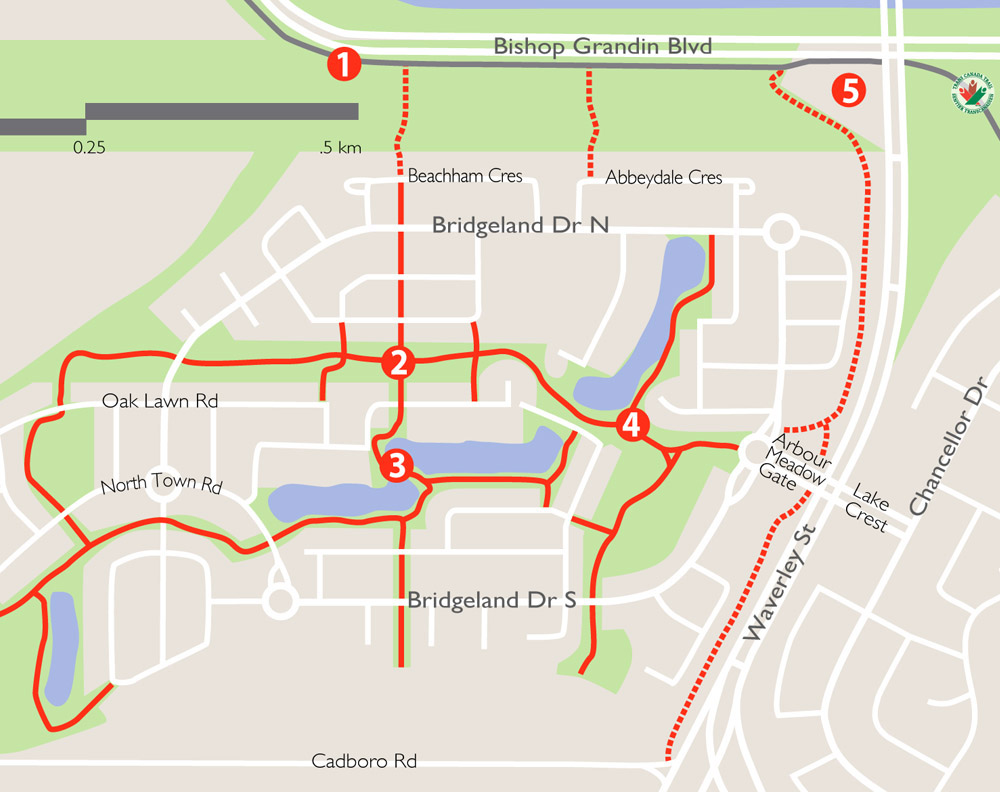
The trail joins Beaverhill Blvd in the Niakwa neighbourhood to the north with Bishop Gandin Blvd to the south, near the intersection with Royalwood's Shorehill Drive.

looking south towards Bishop Grandin
bridge over stormy water ditch
The path is called Shorehill Trail. It was paved and functional about two weeks ago and is currently undergoing some finishing touches. The provincially funded strip of 4-meter wide asphalt was budgeted at $720,000. At less than 300 meters long this new trail is not cheap, at almost $2500 per meter.

A large part of the cost is due to the bridge spanning the storm water ditch that runs along Bishop Grandin. The bridge seems over-engineered for a walking/biking trail to me. Workers have been building that bridge or whatever you want to call it for several months, and have constructed it much like a road bridge over a creek. Installing a prefabricated walking bridge likely would have cost a fraction of the half-million dollars or so that this thing cost, but perhaps they want it to be able to support vehicular traffic -- an ambulance in emergency situations, for example, or an escape route for Niakwanians trapped by a derailed crude oil train.

The primary purpose of this path is to allow kids to safely walk from their homes in Royalwood to schools in Southdale. Previously they would take a shortcut through the ditch or walk along the railway tracks if there was water in the ditch. Somebody who grew up in a small prairie town might say: 'what's the big deal? Just don't go on the tracks if a train is coming.' But I guess there is a new safety standard these days. Everyone is all like 'don't go on the tracks' or 'wear your helmet' or 'don't play with the guns'. Where will it stop? I don't know but I won't complain because this new path personally benefits me.

I run. I bike. I rollerblade. I use the trails in Winnipeg all the time, and I would love to see a network of functional paths connecting the city, allowing people to get around with minimal interaction with traffic, if such a thing is feasible. They need to be functional and well designed though. (Note: a two-meter wide path with a red-light camera stuck in the middle of it is neither ...)

We've made great strides in the past 5 years, but much like Winnipeg's roads, old trails crumble as new ones are built.
painful memories
This photo shows the approximate location of The Incident last week whereby my rollerblade wheels jammed in a crack in the path, slinging me down into the concrete, splitting open the end of my finger and gouging out a gruesome wound in my knee that could take months to heal.

This nameless path is less than half a kilometer from the spiffy new trail shown earlier. Sometimes older cracked paths are repaired temporarily with tar that gets soft and sticky in the sun and the heat. Sometimes paths -- those that are forgotten or deemed less important -- are simply left to break apart. Rarely is a path torn up and redone (although I have seen one example lately).

Even trails that were built only a few years ago have large cracks running through them. This is a reminder that, like our roads, we need to be able to maintain and occasionally rebuild the new infrastructure in addition to the existing stuff. As the network grows, this cost will grow too. It's not slowing down either, as new developments like Bridgwater Forest incorporate trail accessibility into their neighbourhood design.
source: http://www.winnipegtrails.ca
All this trail building seems to be paying off. More people are biking to work than ever before, and even more are using the trails for exercise and recreation. It's a good thing. However, trails will never replace roads in a town like Winnipeg. They instead constitute a duplicate network of infrastructure. Your MLA may secure provincial funding to build a new path in your area, and pose for a picture in your local Canstar paper ... all of which is fine ... but where will the money for the upkeep come from down the road?

All things considered, I think Winnipeg Trails Public Works is doing a pretty good job. It can't be easy to stay on top of repairs to existing trails as all these new ones get built. However, the challenge for the city will be to ensure these hundreds of kms of paths are kept in good shape, and don't end up like this:

.

Tuesday, 2 July 2013

Reston flood update - with pictures

I don't know what's happening with the weather these days, but man, the Gods must be mad about something. Heat waves and massive tornadoes are killing people in the US, and here in Canada it's flooding all over.

Of course everybody knows about the disastrous flooding in Alberta, but recently a pair of freakish storms swept over Reston Manitoba dumping 10 inches of rain in 2 days. I stopped by Reston on my way back to Winnipeg from Saskatchewan to check things out. Here is my report:

****

Hi. Cherenkov here reporting from Reston. As you can see, most of the water has receded from the town, but there is still a lot of work to be done to get things back to normal.

Reston Golf Course - Hole #1
Roughly half the houses in this town have been flooded. Many basements were destroyed, and the foundations of some older houses have crumbled, likely requiring the the houses to be demolished and rebuilt. As of Friday, water continued to rush through the ditches towards town, and pumps were running constantly to drain low-lying areas.

Pumpin' Water

Like most disasters, this was a story of a community coming together to help each other. Families, teenagers, friends of residents, and people who weren't even connected to the town, came to help.

Mennonites from southwest Manitoba descended on the town to help however they could. Some of them were still there on Friday when I visited. They are good folk, those Mennonites. Well ... most of them.

As all the basements were torn apart and emptied onto the streets, volunteers drove around and picked up the garbage, hauling it to a temporary dump at the old elementary school where it was sorted out into giant piles.
Garbage

I know one young man who, with his friends and some others, hauled in rocks to shore up Highway 2 to prevent it from getting washed out. Highway 2 was acting as a dike, holding back water that was building up on the north side of the road. Although water was rushing over the highway, if the road had collapsed the situation would have been much worse.

Note that it was residents and friends who protected the town and shored up the highway -- not the province. Sure, the Premier drove out five days later and toured the area for a photo op, but I've heard that the town and municipality have been on their own to deal with the situation. I do expect, however, that some disaster assistance will be coming their way at some point. We all know how good the province is about doling out flood compensation.

The damage wasn't limited to houses. The CP Rail line through town was washed out.
Rail line on western edge of town
This is a minor line that dead-ends not far into Saskatchewan, and it would not be a surprise if CPR shuts it down rather than repairing it. If so, that would be a blow to the grain elevator in town that was purchased and reopened by some local farmers.

It will take a while for everything to get fixed. If another big storms rolls through I'm not sure what will happen, but them country folk are resilient.
..


/* Google Tracker Code