
On the list of proposed and current Manitoba Hydro capital projects, the Riel Reliability Improvement Initiative Project is one of the lesser known. It is not as big or contentious as Bipole III or Conawapa, but it is still a significant project by most standards.
The $700 million dollar project to "sectionalize" Hydro's southern electricity distribution is intended to improve reliability and facilitate importing power from the US in a circumstance where our power supply suffers a catastrophic failure. You can read more about it on the Hydro web site if you want, but what you should know is that this investment is being made. What you should also know is that, like most of Hydro's recent projects, it is going to be behind schedule and over budget.
Now I don't know that for a fact, but signs are pointing in that direction. The Riel Converter Station was anticipated to be operational by 2014. That gives them 4.5 months to get this thing up and running, and the things that I'm hearing suggest that it is nowhere close.
One problem: one of the lead contractors, Comstock Canada, has declared bankruptcy. Because of its financial woes it failed to pay subcontractors working on the Riel project, and some of those subcontractors understandably stopped working. Comstock owes creditors almost $76 million dollars, ranging from $200 for Windsor Plywood to $3.7 million for Crown Utilities Ltd (which itself has been involved in probably unrelated lawsuits with Manitoba Hydro as recently as 2010.)
With the subcontractors off the job, aspects of the Riel project ground to a halt until eventually Hydro agreed to pay the subcontractors directly. Of course, when one part of a very complex project falls behind schedule, it normally impacts everything else because of overlapping dependencies between the various workstreams. In short, this whole Comstock issue has been very unhelpful.
By the way, Comstock has other troubles too -- it is embroiled in a $50 million lawsuit with Potash Corp and AMEC Americas over a failed project in New Brunswick. Potash Corp terminated their contract because they didn't get their work completed on time or on budget, or to the satisfaction of Potash Corp and AMEC.
Comstock meanwhile claims that Potash Corp and AMEC made life difficult for them by changing requirements all the time. Comstock therefore had no choice but to "perform its work out of sequence, in an 'inefficient' and 'unproductive manner'".
Perhaps it's no coincidence that work on the Riel Station is being performed in an inefficient and unproductive manner.
It is apparently commonplace on that project for work to be repeated or changed on the fly because of poor planning and coordination. For example, concrete will be poured, then it will be torn up because cabling needs to be installed underneath the concrete. Mistakes will happen on a large project, but that sort of thing is happening a lot more than it should on this Riel project.
I can't say if one particular entity is responsible for the poor work flow and mistakes that are made in the construction of this station, I just know that it's not going well, and ultimately it's Manitoba Hydro's responsibility to ensure its projects are properly managed.
I wonder what the new target date and projected cost is for this project...
Sunday, 11 August 2013
Hydro Riel Station Project not going so well.

Monday, 5 August 2013
The City of Winnipeg: Can't it do anything right?
There is this thing called Water Wednesdays. I'm not sure how it started or exactly what it is, but I've see people tweeting about #WaterWednesday on Twitter for the past several weeks. From the 2 minutes and 40 seconds of research that I did, I have deduced that it involves weekly gatherings over the summer in Memorial Park aimed at promoting water stewardship.
Well, I am happy to proclaim that I am doing my part. At least I am trying to...
I have a small vegetable garden in my yard.
 |
| Proof: Beans from my garden |
My intention has been to water it, not with a garden hose, but with rain water collected in my rain barrel.
The rain barrel I got from one of those mad one-day sales that the City of Winnipeg holds every spring. In an effort to encourage sustainable living practices, the city sells rain collection barrels and compost bins at a discount, but only for one day a year and at a few locations around the city. This results in massive lines as people wait, hoping the barrels and bins don't run out before they get their chance to buy one. If you miss your chance to get one that morning, you have to wait another whole year for the next sale (or go to a store and buy one for regular price, but honestly, who would do that?)
I was fortunately able to score a rain barrel in one of these sales, but here's the thing: it's a piece of shit.
A few days after a good solid rain this spring I went to draw water from the barrel, but there was none to be drawn. It was empty. How can that be, I thought. Then after the next rain I tried again, and again it was empty.
The problem: a big crack in the base of the barrel.
I was able to find time on a weekend some weeks later to wash out the barrel and fix the crack using some "fix-all" type of glue that I have.
That problem was resolved and the rain barrel once again filled up with water. And then one morning about a week later as I was walking to the garage, I saw this:
 |
| The weeds next to my rain barrel are doing very well this year. |
If you can't make out the image, it is water gushing out of the side of my rain barrel.
I could fix this leak too, but the barrel is only 2 years old. How many more leaks will there be in year 3, 4 or 5? In addition, the lid to the barrel is cracking from UV damage and the overflow hose is getting brittle and cracking as well.
At first I blamed myself. Maybe I mistreated it somehow. Maybe I was supposed to rub lotion on it every morning to protect it from the sun or something. I was full of regret for having neglected this barrel in some way, until I found out that somebody else I know with the same City of Winnipeg rain barrel had the same sort of cracks appear in theirs as well.
From this, I can only conclude that the rain barrels are pieces of crap.
The city's heart might be in the right place when they hold their annual barrel and bin sale, but their execution is flawed, firstly by making it such a pain in the ass to get one, and secondly by selling faulty barrels.
This Wednesday, as you pause to reflect on our sustainable use of water, ponder this: the rain barrels that the city is selling us to conserve water and preserve the environment are all going to end up in a landfill as big plastic pieces of junk that never did their job.
Sunday, 21 July 2013
Zipper Merge
So I was driving recently on the freeway in Saskatoon and ... oh wait ... maybe I should explain for those of you who have never driven in a city besides Winnipeg: a "freeway" is a road with no stoplights where you can drive at highway speeds. Saskatoon, a city one third the population of Winnipeg, has one. It's called Circle Drive.
As I was saying ... I was driving on Circle Drive in Saskatoon when I approached a construction project to extend the freeway to the west. That's when I saw it: a sign that said "ZIPPER MERGE AHEAD".
 |
| source: http://ckom.com/story/circle-drive-millar-back-normal/110318 |
I quite like it.
It's a nice alternative to the situation that we normally encounter here in Winnipeg. That is, the majority of drivers all pile into the single lane that is continuing, causing a huge backup in traffic. Then a minority of drivers zip ahead and cut in at the front of the line or somewhere close to it.
There are a couple of problems with this, one being that it creates an unnecessarily long traffic queue, another being that it causes animosity among drivers. The drivers who get in line right at the start of the queue and wait patiently as the line trudges along resent the selfish nimrods who zip past them in the empty lane and cut in at the front.
But why should you get in line half a mile before the construction starts when there is a perfectly good lane that can legally take you right up to the merge zone? That isn't rational.
I've been on both sides. Sometimes I get in line, and when I do I get annoyed at those who don't. Depending on what kind of mood I'm in that day, I may even do my best to keep them from merging in front of me. Sometimes, if I'm in an unusually pissy mood, or if the guy trying to merge is driving a pickup truck with a license plate that says "GORJUS" and is wearing a ball cap backwards (I have seen this), I'll even tease them by leaving space for him to merge and then closing up to the car in front of me at the last second, and then I'll go extra slow to give the guy behind me a chance to close up behind me too.
That's how I roll.
However, sometimes I'm the douche bag who zips up the empty lane, although in my head I say to myself "Oops, is this lane closing off? Gosh, I hadn't noticed. I guess I ought to merge over here at some point." -- as if I can telepathically communicate to the drivers waiting in the queue that I didn't mean to drive up the empty lane, it's just that I didn't notice the construction signs. Silly me.
However, I won't drive right to the front of the line because that would be rude, and it would negate the little excuse that I made for myself that I only inadvertently failed to get in line.
This is all normal behaviour, right? Good. Just checking.
Sometimes those who set up the construction sites make it worse than it needs to be. For example, the signage for the construction on the Pembina overpass on the south Perimeter Highway in Winnipeg begins more than 2 kilometers in advance of the lane closure, with signs that warn you that there is a lane closure ahead and the speed limit is reducing to 70 km/h. As a result, most drivers pull over into the right hand lane and slow down to 70 km/h on the highway so far in advance of the construction that you can't even see where the construction begins.
*****
In writing this blog post, I found out that the zipper merge is a new thing for Saskatoon. They only started to experiment with it in May, because, as one person put it, "People have been so bad historically in this city anyway on road construction and merging that anything might improve it".
Saskatoon borrowed the idea from the state of Minnesota, a pioneer in the zipper merge revolution, and so far they have found that it works quite well. My own experience with it was pretty good. I mean, about as good as merging at a road construction site can be. It's not comparable to, say, a full-body hot oil massage, but you know ... it wasn't painful.
The Minnesota Department of Transportation says that the zipper merge "has proven to help traffic flow by decreasing queue lengths as much as 35 percent" and "reduced lane-changing conflicts and sudden-stop crashes."
However, even in Minnesota not everyone is an advocate. One blogger: "I get how the zipper merge is supposed to work, the problem is the people who don’t. ... The zipper merge is going to be this century’s conversion to the metric system in the ’70s. Great idea, made perfect sense, and was dead on arrival."
Much like a roundabout, I don't know how you could fail to understand how it works. Having never experienced such a thing before, I found it exceedingly easy to understand. Mind you, I have underestimated the stupidity of other drivers before.
Even if some people don't catch on to the concept of a zipper, I think it's worth trying out here in Winnipeg because it eliminates the dilemma of deciding between two bad options: burn 5 minutes of your life in a line of cars, or be rude and selfish by cruising to the front of the queue.
Taking turns is something we're taught to do as little kids. As adults driving cars it shouldn't be that hard.
Monday, 8 July 2013
Winnipeg Trails: The old and the new
 |
| looking north |
 |
| looking south towards Bishop Grandin |
 |
| bridge over stormy water ditch |
A large part of the cost is due to the bridge spanning the storm water ditch that runs along Bishop Grandin. The bridge seems over-engineered for a walking/biking trail to me. Workers have been building that bridge or whatever you want to call it for several months, and have constructed it much like a road bridge over a creek. Installing a prefabricated walking bridge likely would have cost a fraction of the half-million dollars or so that this thing cost, but perhaps they want it to be able to support vehicular traffic -- an ambulance in emergency situations, for example, or an escape route for Niakwanians trapped by a derailed crude oil train.
The primary purpose of this path is to allow kids to safely walk from their homes in Royalwood to schools in Southdale. Previously they would take a shortcut through the ditch or walk along the railway tracks if there was water in the ditch. Somebody who grew up in a small prairie town might say: 'what's the big deal? Just don't go on the tracks if a train is coming.' But I guess there is a new safety standard these days. Everyone is all like 'don't go on the tracks' or 'wear your helmet' or 'don't play with the guns'. Where will it stop? I don't know but I won't complain because this new path personally benefits me.
I run. I bike. I rollerblade. I use the trails in Winnipeg all the time, and I would love to see a network of functional paths connecting the city, allowing people to get around with minimal interaction with traffic, if such a thing is feasible. They need to be functional and well designed though. (Note: a two-meter wide path with a red-light camera stuck in the middle of it is neither ...)
We've made great strides in the past 5 years, but much like Winnipeg's roads, old trails crumble as new ones are built.
 |
| painful memories |
This nameless path is less than half a kilometer from the spiffy new trail shown earlier. Sometimes older cracked paths are repaired temporarily with tar that gets soft and sticky in the sun and the heat. Sometimes paths -- those that are forgotten or deemed less important -- are simply left to break apart. Rarely is a path torn up and redone (although I have seen one example lately).
Even trails that were built only a few years ago have large cracks running through them. This is a reminder that, like our roads, we need to be able to maintain and occasionally rebuild the new infrastructure in addition to the existing stuff. As the network grows, this cost will grow too. It's not slowing down either, as new developments like Bridgwater Forest incorporate trail accessibility into their neighbourhood design.
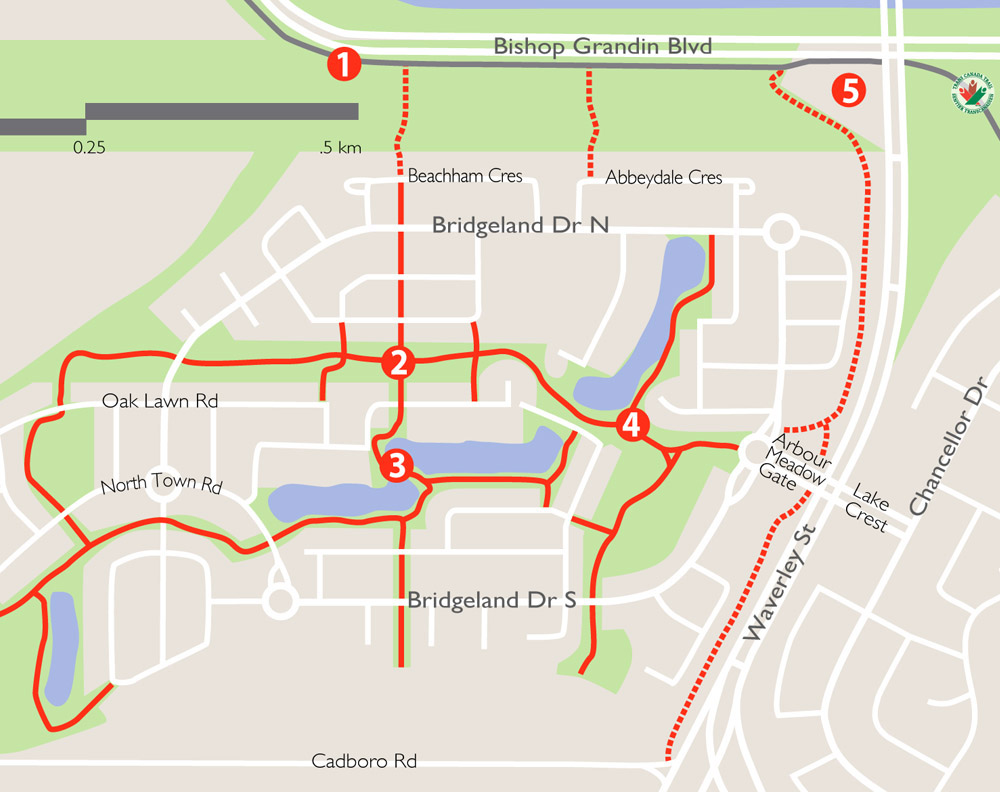 |
| source: http://www.winnipegtrails.ca |
All things considered, I think
 |
| . |
Tuesday, 2 July 2013
Reston flood update - with pictures
I don't know what's happening with the weather these days, but man, the Gods must be mad about something. Heat waves and massive tornadoes are killing people in the US, and here in Canada it's flooding all over.
Of course everybody knows about the disastrous flooding in Alberta, but recently a pair of freakish storms swept over Reston Manitoba dumping 10 inches of rain in 2 days. I stopped by Reston on my way back to Winnipeg from Saskatchewan to check things out. Here is my report:
****
Hi. Cherenkov here reporting from Reston. As you can see, most of the water has receded from the town, but there is still a lot of work to be done to get things back to normal.
 |
| Reston Golf Course - Hole #1 |
 |
| Pumpin' Water |
Like most disasters, this was a story of a community coming together to help each other. Families, teenagers, friends of residents, and people who weren't even connected to the town, came to help.
Mennonites from southwest Manitoba descended on the town to help however they could. Some of them were still there on Friday when I visited. They are good folk, those Mennonites. Well ... most of them.
As all the basements were torn apart and emptied onto the streets, volunteers drove around and picked up the garbage, hauling it to a temporary dump at the old elementary school where it was sorted out into giant piles.
 |
| Garbage |
I know one young man who, with his friends and some others, hauled in rocks to shore up Highway 2 to prevent it from getting washed out. Highway 2 was acting as a dike, holding back water that was building up on the north side of the road. Although water was rushing over the highway, if the road had collapsed the situation would have been much worse.
Note that it was residents and friends who protected the town and shored up the highway -- not the province. Sure, the Premier drove out five days later and toured the area for a photo op, but I've heard that the town and municipality have been on their own to deal with the situation. I do expect, however, that some disaster assistance will be coming their way at some point. We all know how good the province is about doling out flood compensation.
The damage wasn't limited to houses. The CP Rail line through town was washed out.
 |
| Rail line on western edge of town |
It will take a while for everything to get fixed. If another big storms rolls through I'm not sure what will happen, but them country folk are resilient.
 |
| .. |
Friday, 14 June 2013
We're gonna need a bigger bus.
Thank God for preseason games, is all I can say after Wednesday night. There are a lot of bugs to work out in the Bombers' new system.
I'm talking about the transportation scheme (although the Bombers' on-field game, um ..., has a few holes as well). I'm sure it looked great on paper, but holy smokes ...
There were two main busing options from my neighbourhood: the special Bomber Blue & Gold Express, and a regularly scheduled University bus. There were two Express buses scheduled, but I wanted to get to the stadium early so I could wander around and check things out, so I left the house almost an hour and a half before the game to catch a regular bus.
Ya, good thinking there cherenkov ... the bus I wanted to catch was 25 minutes late, and when it came it was packed full and I couldn't get on. I would have been no better off waiting for the Express ... there was a line-up of 60 people when I walked by there, and this was stop number 2 on the route. Only about half were able to get on the first Express bus. The bus driver then proceeded on it's route to pick-up point number 3 knowing full well that he wouldn't be able to pick anybody up.
Anyhow, I finally got to the stadium, but a good 10 minutes late for kickoff. I would have missed more of the game had I not gotten off the bus at Pembina Hwy and walked the rest of the way. You see, this is a two-pronged problem: a lack of buses and massive traffic bottle necks. From my perch up in the nose bleed section of the the new ball park, I could see buses lined up on University Crescent right up to the end of the first quarter, when this photo was taken:

Bus Math
I can't help but think a little math would have gone a long way in ensuring sufficient bus service to the stadium. The stadium holds about 30,000 people. There are 5,500 parking spots at the stadium. (I heard there were problems with the parking too, but I won't get into that.) If we assume two people per car, that's 11,000 people parking, leaving 19,000 other people who have to get to the ball park some way.
The Bombers asked people to take the bus, and people took the bus. Winnipeg Transit said they accounted for 5000 people taking the bus but that 8500 people actually did take transit (or attempted to?).
I don't know why they only accounted for 5000 people when 19,000 people needed to get to the stadium and no on-street parking is available in the area. But even if only 5000 people were to take the bus, I don't think they had that covered. Most Winnipeg Transit buses seat 38 people, so let's say 60 people cram on a bus in total. The transit plan had 45 total Express buses for game day service -- the Blue & Gold Express and the Park & Ride Super Express. 45 x 60 = 2700 people. This barely covers half of the passengers that they anticipated.
They also had extra service on the 161 route from downtown, the last of which was optimistically scheduled to leave the U of W at 6:20 and get to the stadium 10 minutes before kick-off. There was no other extra service from any other areas of the city, leaving people to rely on the minimal Express service or the overloaded regular University buses.
Anyhow, they will no doubt add more buses for the home opener later this month, which may solve problem #1: not enough buses, but it doesn't solve problem #2: massive gridlock. In fact, it may make it worse.
I can't help but point out at this stage that had our waffling leaders put rapid transit in place before the stadium was built this might not have been such a big problem.
So what's a person to do? I thought I might bike next time, but even the volunteer-driven bike valet was overwhelmed.
It is a conundrum...
I have thoughts on the new Investors Group Stadium too, but those will have to wait for another day. I'll just say this: it is very nice in some ways, but there are still some big shortfalls including congestion problems within the concourse. But hey, the Rum Hut made it over to the new place!

Monday, 10 June 2013
Gordon Bell's Field of Reality
Monday June 10 at 10:30am, there were be an official unveiling of the new "Field of Dreams" for Gordon Bell High School.
I wrote a few blog posts about this particular project back when it was starting, and I have to admit that I was not entirely supportive. Much of that has to do with the way in which the project came about. This piece of real estate on the edge of downtown was vacated by a car dealership in February of 2007. Canada Post bought the land over half a year later, in November of 2007, and had already designed a facility to fit the unique area when the movement to turn the area into green space began in September of 2008 with this Free Press editorial by Nancy Chippendale.
In the wake of the Upper Fort Garry debacle, where a highrise apartment development was toppled very late in the game by the 'Friends of Upper Fort Garry' to make room for an expensive and unnecessary interpretive centre, I was not sympathetic to additional efforts to replace in-progress development with supposed green space.
However, I have slowly come around and I'm willing to acknowledge that this Field of Dreams concept is mostly a good thing. After all, there are several important differences between this project and the Upper Fort Garry SNAFU.
- The land was vacant for a much shorter period of time. There was a year and a half between the closure of the dealership and the start of the movement to build a recreation field on the site. It takes a bit of time for people to recognize an opportunity and get organized, so this is not unreasonable. By contrast, the area on which the UFG interpretive centre is supposed to be built was a little-used parking lot for as long as I can remember. It was only when a developer saw the value of the land and decided to make use of it that the "Friends" jumped in to "save" it.
- The Field of Dreams movement was a grass roots movement, driven by the community to fulfill an actual need in the community. By contrast, the UFG project is the work of an elite, wealthy cabal to build something that is not needed by anyone.
- The Field of Dreams is achievable and affordable. It wasn't cheap -- the bill will reach close to $7 million or perhaps more, including land purchase -- but with fundraising by students, an actual desire for the project and will to make it happen, things eventually fell into place. By contrast, the Upper Fort Garry project is unaffordable, and will probably never be completed as planned. A park on the foot print of the old fort will indeed be built, but it would have been built in any event, in some form or another, with or without the Friends of Upper Fort Garry. However the elaborate plans that the Friends have cooked up for the park still require an extra $3 million to finish, and then they have to raise another $5 million or so for the interpretive centre which is the specific part of the project that the residential development was killed for. That money will be very hard to come by, when there are so many other causes that provide community benefit or greater exposure for donors. That is why the site is still a parking lot, and it will remain a parking lot for the foreseeable future.
*****
The design of the actual site is quite nice, and fairly true to the original diagram by Scatliff Miller Murray (h/t MrC):
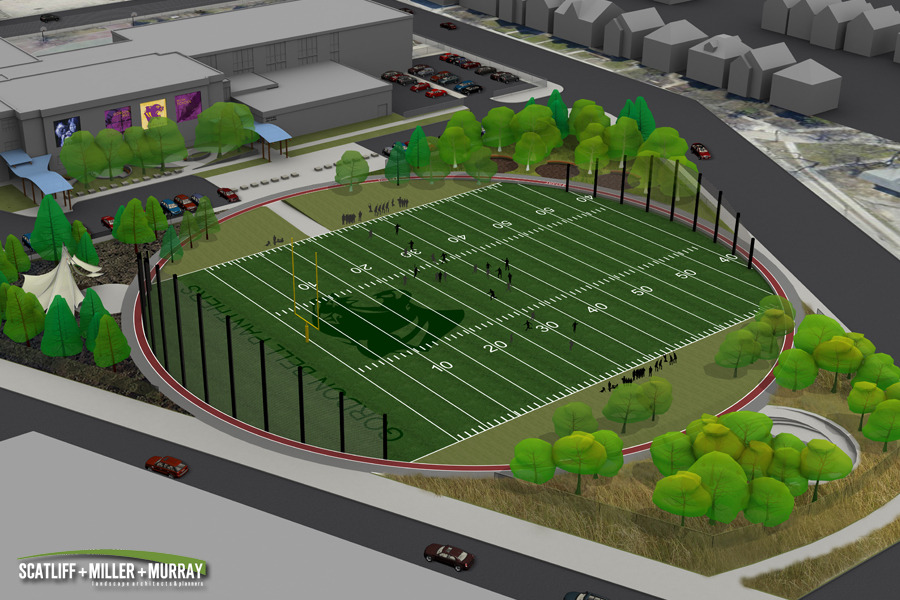
It should be noted that although a standard high school soccer field could fit in this space, as I showed in that previous post, they chose not to do that. Instead they opted for a north-south orientation in the middle of the space, which is an elegant design with the circular track around it, but it necessitates a smaller field.

About that track ... it is quite narrow, so there will be no racing around it. It also merges with the sidewalk at one point which is certainly less than ideal.

However this is mostly nit-picking. Compared to what the students of Gordon Bell had before (i.e. nothing), this is a fabulous facility. I hope they get good use out of it, and I hope that my car insurance premiums don't go up too much because of soccer balls flying onto Portage Avenue and causing accidents.